Which documents come with the shipment?
The certificate is the one your engineer will read; the rest is what clears the goods. Both are prepared before loading, not after.
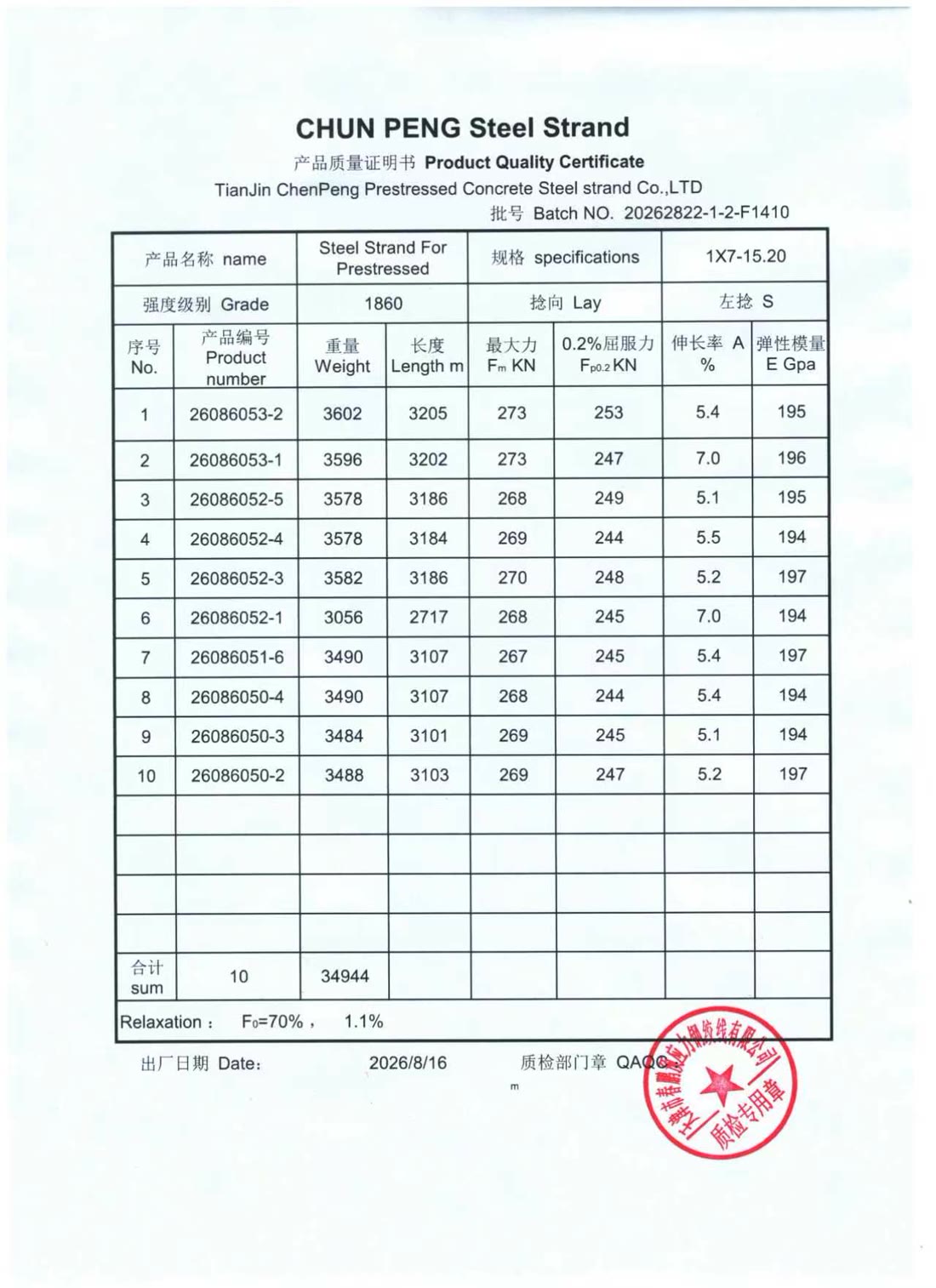
The document set
| Document | Issued by | Purpose |
|---|---|---|
| Batch quality certificate | Mill QA department | Proves the mechanical properties of your batch: Fm, Fp0.2, elongation, modulus, relaxation |
| Commercial invoice | Turun Steel | Customs value, payment, HS code |
| Packing list | Turun Steel | Coil count, weights, dimensions, marks |
| Bill of lading / road waybill | Carrier | Title and delivery receipt |
| Certificate of origin | CCPIT or customs | Origin declaration, preferential treatment where applicable |
| Third-party inspection report | SGS / BV / nominated surveyor | Independent verification before loading, on request |
Reading the certificate
Four numbers matter. Fm is the measured breaking load — compare it with the minimum for your size (260.4 kN for 15.2 mm at 1860 MPa). Fp0.2 is the 0.2% proof load, normally about 88–90% of Fm. Elongation should be comfortably above 3.5%. Relaxation is the percentage loss at 70% of breaking load over 1,000 hours, and the limit is 2.5%.
If the certificate gives only one line for a whole heat rather than per coil, ask why — per-coil reporting is the norm for this mill.
Before you pay
Ask for the certificate of a recent batch in your size before placing the order. It tells you more about the supplier than any brochure: the numbers, the traceability, and whether the format is something your consultant will accept.